A Knowledge Panel is the entity card to the right of, or above, the search results that Google renders from its Knowledge Graph once a person, brand or organization is treated as a uniquely identifiable entity with sufficient trust. It is not a ranking product but a structural representation. According to Google's help center, it is generated automatically from data partners, open web sources and suggestions by verified entities. In practice, that means several independent sources, structured data and authoritative references have to confirm the same facts.
This piece shifts the perspective. Away from the popular question "How do I get a Knowledge Panel?" toward the strategically durable one: how do I build an entity Google cannot help but represent in its graph? The basis is Google's official help pages, the rules of Wikidata and Wikipedia, and our own observations from a two-digit number of personal-brand and organizational projects. Our own observations are labeled as such.
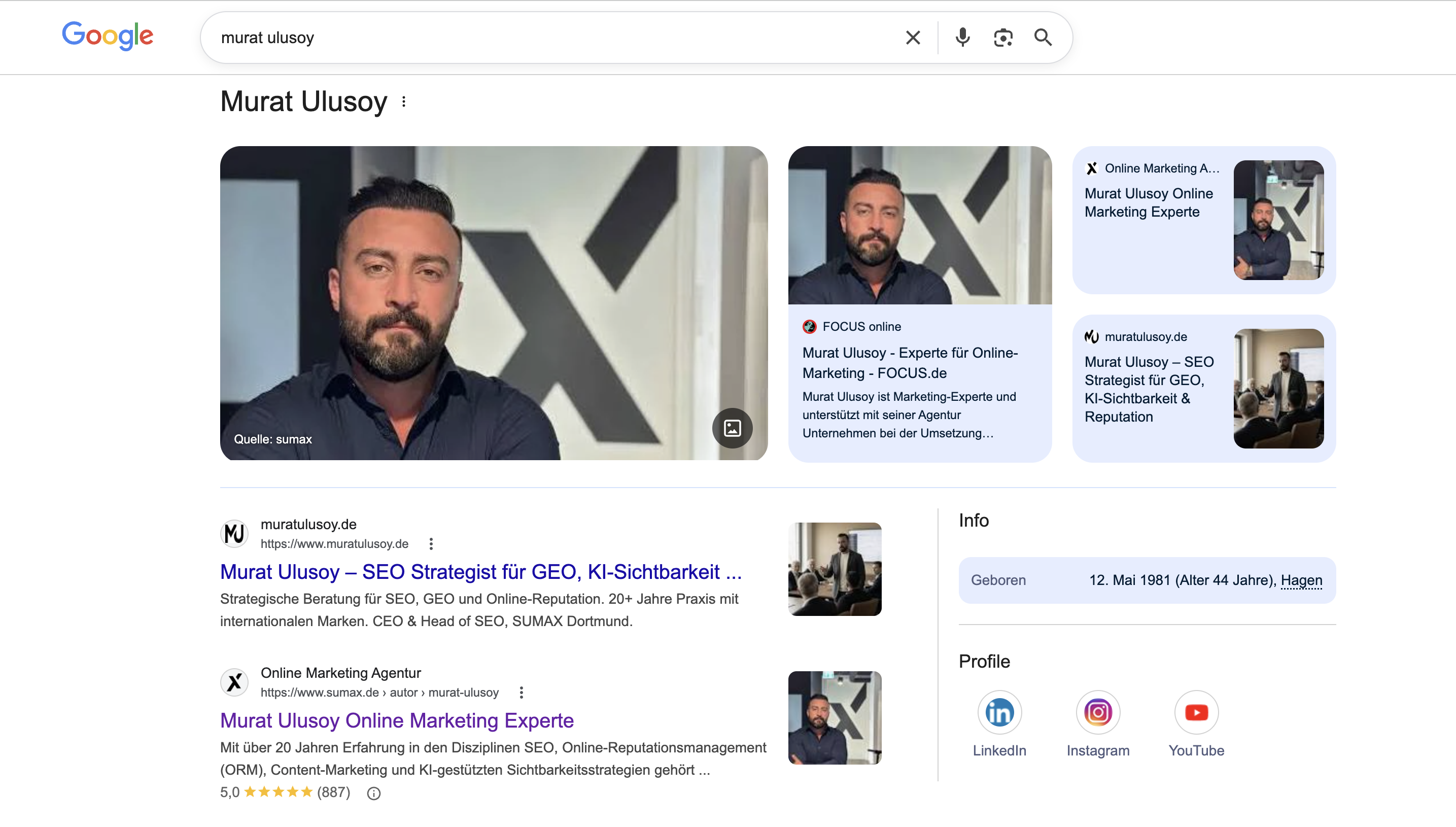
The wrong question: "How do I get a Knowledge Panel?"
The question is popular, but it describes a categorical mistake. It treats the panel as a placement you can buy, lobby for or force technically. In reality, a Knowledge Panel is the result of a threshold: Google does not decide "does this person deserve a panel?" but "is the entity in my graph unique enough to show to the user?". Those are two completely different verification mechanisms.
The consequence: every measure aimed directly at the panel — bought Wikipedia articles, fake PR with boilerplate repetition, coordinated profile swarms — addresses the symptom, not the cause. In advisory practice with executives across DACH and international, panels produced by such shortcuts have regularly experienced corrections, content losses or full deletions within a containable timeframe. The real panel question is an entity question.
Knowledge Panels are generated automatically, according to Google; you can only claim a panel that already exists
official accounts for verification when claiming: YouTube, Search Console, X/Twitter, Facebook (Google help)
months to panel emergence in our projects with clean entity work (own observation, no guarantee)
What is a Knowledge Panel, and how does it appear?
A Knowledge Panel is an information box in Google Search that summarizes a person, organization, place or work at a glance. According to Google's own help page, it is generated automatically from the Knowledge Graph, fed by data partners, open web sources and suggested edits from verified entities. Google's help center describes no way to apply for one.
If a panel already exists, you can claim it: verification runs through an official account such as YouTube, Search Console, X/Twitter or Facebook, after which you can suggest changes. Google notes that not every panel is claimable yet, and local businesses use their Business Profile instead. Everyone else sends feedback through the link on the panel. Whether a panel appears at all depends on how clearly and consistently Google can confirm the entity from independent sources, structured data and profiles. Wikipedia and Wikidata can help but are not an official requirement. Nobody can guarantee a Knowledge Panel.
Technically, a panel is not a document and not a page but a projection from the Google Knowledge Graph into the SERP template. The graph holds a node with an ID (older entities carry a Freebase-era MID such as /m/02_286, newer ones a kgmid), which the Knowledge Graph Search API also returns. It is linked to attributes (name, occupation, date of birth, organization) and edges (sameAs relations, authorship, participation). When Google launched the Knowledge Graph in 2012, its announcement named Freebase, Wikipedia and the CIA World Factbook among its sources.
Our working hypothesis, which Google does not document in this form: the panel is rendered only when confidence crosses an internal threshold and the entity is, at the same time, relevant enough to a query. Both conditions are independent: a stable entity without query demand stays invisible. An entity with high query demand but uncertain attributes is withheld — Google avoids false claims in highly prominent SERP slots.
Symptom versus cause
This distinction is operationally central. Brands that want a Knowledge Panel must work on the cause — the graph node. Brands that work on the output (e.g., correcting the wrong photo through the Google feedback form) can groom the symptom, but cannot produce the entity. Operationally: structured data, authority signals and corroboration are cause. The panel itself is reporting.
Why Google is conservative
The Knowledge Graph is the trust infrastructure behind AI Overviews, Gemini answers, featured snippets and voice assistants. Every error multiplies across dozens of products. That is why Google prefers missing panels over wrong ones. The threshold is not "plausible enough" but "verified across multiple sources and free of contradictions".
The three signal classes: corroboration, authority, structured data
| Signal class | What Google checks | Examples of strong signals | Typical weaknesses |
|---|---|---|---|
| Corroboration | Consistency of the core facts across independent sources | Same name, title, company on website, LinkedIn, Crunchbase, press | Diverging titles ("Founder" vs. "CEO"), inconsistent spellings |
| Authority | Reputation of the confirming sources | Wikipedia, Forbes, trade journals, professional associations, ORCID | Blog networks, PR-wire-only mentions, guest pieces without editorial review |
| Structured data | Machine-readable entity definition | Person/Organization schema with a complete sameAs |
Missing @id, broken sameAs, schema only on the About page |
All entity-trust signals fall into three classes. Each class is necessary; none is sufficient alone. Strong authority without corroboration produces mistrust. Clean structured data without external confirmation produces an empty node. Corroboration without authoritative anchors remains noise.
Corroboration — the agreement of facts
Corroboration is the independent, multi-source confirmation of the same facts. The test question is roughly: is the name "Murat Ulusoy" mentioned on several independent sources (our rule of thumb: three to five) with identical role, company and activity? The consistency of NAP data (name, address, phone) across 7-10 curated, genuinely authoritative profiles is the minimum fingerprint from which corroboration emerges — quality over quantity.
Authority — the source hierarchy
Not every source counts equally. Wikipedia, major general-interest media (FAZ, SZ, Handelsblatt, Spiegel, The Times, FT), established trade publications (t3n, iBusiness, Search Engine Land) and academic databases weigh many times more than an arbitrary industry profile. Authority signals are the reason purely profile-based strategies stagnate. The graph needs anchors with editorial review.
Structured data — the machine readability
The third class is where most operational errors happen. Person and Organization schema with a complete sameAs block on the own domain is mandatory. Without that block, Google has to reconstruct the entity by inference from plain text — a constant source of entity drift. With clean schema, the inference cost falls and confidence rises.
curated, authoritative profiles with NAP consistency as the corroboration base (rule of thumb from our practice)
independent, reputable sources: the same orientation Wikidata's self-promotion essay gives
removal risk for panels and entries built on bought or coordinated signals (own observation)
The systematic error: panel hacking
Panel hacking describes the attempt to force a Knowledge Panel through bought PR, coordinated profile networks, ordered Wikipedia edits or manipulative structured-data injections. The technique works occasionally — short-term. In our advisory practice, we have seen the clear majority of such panels disappear or get trimmed over a medium period. Our explanation: statistically unnatural corroboration patterns stand out. On Wikipedia, an extra rule applies: anyone paid for contributions must disclose employer, client and affiliation under the Wikimedia Terms of Use.
Typical signatures we see in audits: identical biography boilerplates across 20+ profiles within two weeks, sudden linking from coordinated author accounts, Wikipedia articles with non-notable sourcing that are flagged by deletionist editors shortly after publication. Each pattern is a signal — together, they are a clear one.
The delete-penalty effect
A deleted panel is harder to rebuild than one that never appeared. Re-entries after a panel deletion typically extend build-up time substantially and require additional authority investment in the order of the original build-up, in our observation. Google documents nothing about this publicly; a plausible explanation is that contradictory or removed sources weigh on confidence for longer. For CMOs, that means: the cheapest shortcut is the most expensive long-term option.
"A Knowledge Panel is not a reward for marketing effort. It is the sober expression of the fact that an entity exists in Google's model of the world — consistent, verifiable, and without contradiction."
Why shortcuts are economically irrational
Offers for panel shortcuts often run into four or five figures, based on our market observation, with an expected short hold period. Entity-trust work runs at comparable or lower own-time sums plus targeted PR investment, with an expectedly far longer hold period and secondary effects on AI citation rate, branded search and LLM reputation. The difference is not 2× or 5× — it is structural.
Entity trust as a system — the six-layer model
We work with a layered model that decomposes Google's confidence-building transparently. Each layer is necessary; if one is missing, the score stays below panel threshold. The total score is a weighted sum:
EntityTrust = (0.25 × Identity)
            + (0.20 × Corroboration)
            + (0.20 × Authority)
            + (0.15 × StructuredData)
            + (0.10 × Consistency)
            + (0.10 × Notability)

Panel threshold (working value from our practice, not a Google value): EntityTrust ≥ 0.72

Layers:
Identity        = unique name disambiguation, collision score
Corroboration   = agreement of facts across independent sources
Authority       = source-hierarchy weighting (Wiki/FAZ/trade media)
StructuredData  = Schema.org Person/Org + sameAs completeness
Consistency     = NAP agreement across the curated core profiles
Notability      = Wikidata notability criteria met
The weighting is our own calibration from advisory practice, so it is a model, not a formula confirmed by Google. It is an operator tool: it forces teams to work on all six layers, not only the visible two.
Where most projects fail
- Identity — underestimated name-collision score, no disambiguation strategy.
- Notability — Wikidata notability criteria not met, hence no entry, hence no foundation.
- StructuredData — sameAs block incomplete or with dead URLs.
- Consistency — NAP data on older profiles not updated; entity drift goes undetected.
Schema.org implementation: Person + sameAs done right
The E-E-A-T-relevant technical lever is a consistent Person schema on the entity's main domain, embedded as JSON-LD, with a sameAs block that consolidates every authoritative profile. Order and selection are not arbitrary: LinkedIn, Wikidata (as Q-ID URL, only if a policy-compliant item exists), Wikipedia (where it exists), Crunchbase, GitHub (for technical profiles), ORCID (for academic profiles), corporate profile page.
<script type="application/ld+json">
{
  "@context": "https://schema.org",
  "@type": "Person",
  "@id": "https://www.example.com/#person",
  "name": "Max Muster",
  "alternateName": "Dr. Max Muster",
  "jobTitle": "CEO & Head of Strategy",
  "worksFor": {
    "@type": "Organization",
    "@id": "https://www.example.com/#org",
    "name": "Example GmbH"
  },
  "url": "https://www.example.com/",
  "image": "https://www.example.com/images/max-muster.jpg",
  "sameAs": [
    "https://www.linkedin.com/in/maxmuster/",
    "https://www.wikidata.org/wiki/Q123456789",
    "https://en.wikipedia.org/wiki/Max_Muster",
    "https://www.crunchbase.com/person/max-muster",
    "https://orcid.org/0000-0000-0000-0000"
  ]
}
</script>
Three typical mistakes show up in the majority of our audits. First: sameAs URLs lead to redirect chains or 404s — every dead link is a trust deduction. Second: the schema exists only on the homepage, not on a dedicated person page with an @id anchor. Third: alternateName is missing, even though the entity is known under variations (academic titles, short forms, alternative spellings).
Wikidata as foundation — and its pitfalls
Wikidata is an open, machine-readable knowledge base. Unlike Wikipedia, it consists of entities (Q-IDs) with typed properties. Its link to Google is documented historically: from 2014, Google handed the content of its Freebase database over to Wikidata (Pellissier Tanon et al., 2016). How much weight Google gives Wikidata today is not documented. To verify a Knowledge Panel, use Google's official claim process; a policy-compliant Wikidata item can additionally strengthen the fact base.
The central hurdle is notability. Under Wikidata:Notability, an item is acceptable if it meets at least one criterion: a valid sitelink to a Wikimedia project, a clearly identifiable entity that can be described using serious and publicly available references, or a structural need. The essay Wikidata:Self-promotion strongly discourages creating items about yourself or your own organization and suggests three independent, reputable sources as orientation. Anyone without that evidence risks a request for deletion.
Property hygiene
A technically sound Wikidata entry maintains at least: P31 (instance of), P106 (occupation), P1416 (affiliation), P856 (official website), P2002 (X/Twitter), P2037 (GitHub) and — critically — references per property to external sources. A Wikidata entry without references is an entry on call.
Language labels
For international entities, multilingual labels and descriptions are not optional. A consistent de, en, tr, fr label raises the chance that Google recognizes the entity as identical across markets and does not model it as separate entities per language space.
| Dimension | DIY approach | Professionally accompanied |
|---|---|---|
| Time effort (client) | 40-100 h over 3-12 months | 2-4 h onboarding, then monitoring |
| Required skill level | Schema markup, Wikidata syntax, SEO fundamentals | None — covered externally |
| Wikidata notability risk | High — notability rejection common | Lower, because notability is checked up front (disclose paid work) |
| PR quality | Variable, often PR-wire-only | Editorial trade media, verified |
| Typical panel time | often 6-12 months, uncertain | often 3-6 months, no guarantee |
| Error risk | Moderate to high | Low, documented |
| Cost range | Own time + EUR 3-10k external PR | EUR 3-15k, project-dependent |
When does a Knowledge Panel appear, and when not?
A panel appears only once Google can identify the entity unambiguously and enough people search for it. Our observation from advisory projects (own data, not a representative sample): panels typically appeared two to six weeks after the moment the entity-trust threshold is crossed — but only if there is sufficient query demand. Without search volume on the name, the entity remains present in the graph but lacks a SERP projection.
We also see situations in which no panel appears for a long time despite strong signals: minors, people in active legal proceedings, entities in reputational disputes, and people in regulated industries (finance, medicine, law). Google documents no fixed rules for this; we suspect higher quality requirements for YMYL topics.
Order beats speed
In our projects, panels became visible fastest when independent coverage and complete schema were already in place before structured entries such as a Wikidata item were added. Reversing the order (Wikidata first, evidence later) risks a deletion request for lack of notability and, in our cases, cost several months. Own observation, not a representative sample.
The 8-step path to a Knowledge Panel — documented and expanded
The following sequence combines what Google's Knowledge Panel help officially describes with the approach common in the entity-SEO industry. Each of the eight steps is summarized here in its core text and then extended with operational detail from our own advisory practice, so the step reads as a functional building block rather than a checklist.
Step 1 — Understand what Google actually wants
Google does not grant panels as favors. A panel appears when the Knowledge Graph has enough confidence that a distinctive, notable entity exists. That confidence rests on three pillars: corroboration — multiple independent, authoritative sources confirm the same facts; authority — Wikipedia, major news media, trade publications and established databases as anchors; structured data — schema markup on websites that defines the entity machine-readably.
Expansion: Google itself states in its Knowledge Panel help that panels are generated automatically from data partners, open web sources and suggestions by verified entities. The operational consequence is uncomfortable but clear: panels are the symptom of a confidence gain, not a purchasable product. Brands that work on the panel are working on the wrong end of the value chain — correct work targets the three pillars from which confidence emerges.
Step 2 — Audit the current online presence
Before any build-up comes the inventory: what does Google see today? An incognito search for the full name. Does a panel already exist? What dominates page 1 — LinkedIn, the own website, news, or nothing reliable? Are there name collisions with others bearing the same name? Is data consistent across platforms, or does it contradict itself on role, company or location?
Expansion: alongside manual SERP review, the Google Knowledge Graph Search API (which Google says is not suitable as a production-critical service), SERP tools such as Ahrefs or Semrush for brand-SERP monitoring, and the Wikidata reconciliation service deliver useful signals. Bing Entity Search is gone: Microsoft retired the Bing Search APIs on August 11, 2025. Name-collision cases — especially with common Turkish names or everyday names — require a clear disambiguation strategy: a consistently used middle name, an academic title or a stable role descriptor as suffix.
Step 3 — Establish the entity home
The entity home is the one page Google treats as the primary source of truth about the entity — usually the About page on the own website. Required: full name in H1, a professionally written bio (who, what, credentials, affiliations), links to every verified social profile, a high-quality headshot, and Schema.org Person with name, job title, organization, social links and image.
Expansion: in 2026 that minimum is no longer enough. Add knowsAbout (topic entities), alumniOf, award and hasCredential. The page must sit at a stable, canonical URL (pattern: /about/first-last/) and internally link to the knowsAbout destination pages — generating the co-occurrence signals Google uses for thematic placement of the entity.
Step 4 — Standardize every profile
Google references information across platforms. Contradictions such as "CEO at Acme Corp" (LinkedIn), "Founder, Acme" (Twitter) and "Managing Director, Acme Corporation" (website) confuse the entity resolver. Standardize: name (same spelling, no abbreviations), title, company, core bio facts and profile photo. Typical platforms: LinkedIn, X/Twitter, Instagram, Facebook, YouTube, Crunchbase, Bloomberg (where applicable), own website, company bio, industry directories, podcast guest profiles and speaker bios. In practice, you curate 7-10 strong core profiles from these and maintain them consistently — hours, not minutes.
Expansion: a NAP register as a structured table (Google Sheet, CMDB, Notion database) is mandatory. Maintenance runs quarterly, flanked by name monitoring through Google Alerts and Mentionlytics. Every drift case is corrected at source, not commented on.
Step 5 — Check Wikidata, do not force it
Wikidata is the structured backbone behind Wikipedia. A Wikipedia article is not a prerequisite for a Knowledge Panel — a widespread myth. Neither is a Wikidata item: Google's help names no specific database as a required source. A policy-compliant item can still strengthen the fact base. It is created on wikidata.org; the claims (name, date of birth, occupation, employer, website, social profiles) are each backed by references from independent secondary sources; self-published sources are usually rejected. Risk: Wikidata editors can delete the item for lack of notability, and a deleted item makes the starting position worse. Creating items about yourself or your own company counts as self-promotion under the self-promotion essay and is strongly discouraged.
Expansion: before creating, a notability check against WD:Notability (a valid sitelink, or a clearly identifiable entity with serious, publicly available references, or a structural need). Paid contributions fall under the disclosure duty of the Wikimedia Terms of Use. Maintain properties consistently: P31 (instance of), P106 (occupation), P108 (employer), P856 (official website), P2003 (Instagram), P2013 (Facebook), P2002 (X/Twitter), P496 (ORCID iD). Multilingual labels for every target market are standard, not exception.
Step 6 — Build press and authoritative mentions
Google needs independent third-party sources to confirm the facts. The strongest signals: expert articles in publications Google trusts (major general-interest media, industry trade media), interviews, podcast features, guest pieces, industry databases (Crunchbase for founders, IMDb for media professionals), professional-association listings. In our experience, one real feature in an industry publication weighs more than many press releases, because only editorial coverage is independent confirmation.
Expansion: editorial coverage follows the contribution-value principle — exclusive data, primary research, pointed opinion. Target media can be prioritized by domain authority and editorial reach. Guest contributions in field-relevant publications (for SEO topics, Search Engine Land, Search Engine Journal, t3n, OMR) build topical authority in parallel with the entity and anchor the person in the semantic neighborhood of their field.
Step 7 — Implement technical SEO signals
Beyond the entity home, technical signals are mandatory: sameAs properties in the schema pointing to every verified profile; NAP consistency across every business listing; Google Search Console verified for the website; correct crawlability (no noindex on core pages). Sitelinks searchbox markup is no longer needed: Google stopped showing the sitelinks search box on November 21, 2024.
Expansion: in addition, Organization is chained to Person via worksFor, Article schema uses an author reference (@id) to the Person node, ImageObject is added as image property with width, height and caption. Google Merchant Center and Google Business Profile must be verified where applicable; Bing Webmaster Tools and Bing Places complete machine readability. Crawl budget: the entity home must have a low click depth — at most two clicks from the homepage.
Step 8 — Wait (and hope)
Even with correct execution, there are no guarantees. Google recrawls and reprocesses on its own schedule. In our projects, panel emergence took four to six months for some entities and six to twelve for others. Name collisions or insufficient authority can prevent a panel even after full execution. Shortcuts — spammy link building, fake press, bought Wikipedia edits — can briefly trigger a panel and then lead to its deletion, and a deleted panel is markedly harder to rebuild than one that never appeared.
Expansion: the waiting time is not a passive interval but an active reinforcement phase. It includes content production with consistent entity co-occurrences, continued maintenance of the Wikidata item, weekly tracking of Google Knowledge Graph API responses, and controlled expansion of third-party sources. If the panel has not appeared after roughly nine months, a notability re-audit by a neutral third party follows — which usually identifies the precise layer (corroboration, authority or structured data) where confidence remains below threshold.
The six-month protocol: build entity trust instead of chasing the panel
The following protocol is the condensed, monthly-paced rollout version of the eight steps above — compressed for the onboarding sequence with personal brands and mid-market organizations. It is structured monthly on purpose, not because each step takes a month, but because the maturation time between steps is needed for Google's crawl and verification cycles.
- Month 1 — entity audit and name-collision check. Review the existing Knowledge Graph footprint (Google KG Search API, search-operator sampling). Build a name-collision matrix: every namesake with public visibility, weighting their respective entity-trust scores. Define a disambiguation strategy (use a middle name, carry an academic title consistently, establish a role descriptor as suffix).
- Month 2 — implement Schema.org Person/Organization. Roll out Person or Organization schema with a complete sameAs cluster on the own domain. Dedicated person page (
/about/max-muster/) with an@idanchor. In parallel, mirror NAP data across 7-10 curated, authoritative profiles. Every profile: same photo, same name, same role, same company link. - Month 3 — check the Wikidata foundation. Check notability against WD:Notability. Only if independent, reputable sources document the entity, have an item created, ideally by independent editors; disclose any own or paid interest. Back claims with references, maintain properties cleanly (P31, P106, P1416, P856). Link external IDs (ORCID, LinkedIn URL, Crunchbase). Add multilingual labels for relevant markets.
- Month 4 — corroboration through authoritative media. At least three independent trade-media features with consistent facts (role, company, location, career). No pay-for-placement. Focus on industry publications with editorial substance and their own Schema.org author block.
- Month 5 — densify authority signals. Speaker roles at conferences, board memberships, authorship in trade journals, citations in studies. Every signal with a machine-readable fingerprint — speaker profiles with author schema, podcast entries with structured guest lists, GitHub/ORCID/Google Scholar links.
- Month 6 — monitoring and entity-drift control. Quarterly Google Knowledge Graph API check. Monitoring of third-party databases for incorrect facts. Where entity drift occurs (wrong photo, outdated position, name collision), correct it through source updates — never through the panel feedback form alone.
The protocol is intentionally free of "panel-trigger tricks". Every step addresses one of the six trust layers. If the system holds, the panel emerges as a by-product. If it does not, that itself is diagnostically valuable: a layer is weak, and the audit shows which.
Limits, risks and honest expectations
No protocol guarantees a panel. In our advisory practice, panels appeared in the majority of cleanly executed cases; the cases without panel emergence fall into two groups: insufficient notability (no robust secondary sources in the sense of the Wikidata criteria) and high name collision with already established holders of the same name, where disambiguation needs more time than the observation window.
More honest than guarantee rhetoric: a clean protocol lifts panel probability from a very low starting level to a qualitatively durable level, in our projects within a window of several months to roughly a year. Sharper numbers without a controlled study base are marketing. The real upside is secondary: even when no panel emerges, the work improves the basis for AI citations in our observation (see prompt-level SEO) and for visibility in AI Overviews.
Reputation coupling: panel and LLM trust travel in parallel
A strategic side effect is often overlooked. The entity-trust build-up that produces the panel as a by-product simultaneously raises the probability that LLMs (ChatGPT, Claude, Gemini, Perplexity) model the entity correctly and cite it in answers. Wikipedia is demonstrably part of such training data: for GPT-3, the OpenAI paper (Brown et al., 2020) reports that 3% of the training mix came from English Wikipedia, which at about 3.4 passes was seen more often than any other source. Which structured sources current models use is mostly not disclosed. Knowledge-graph build-up therefore often carries over into LLM answers.
For senior brands, that means: the budget for entity-trust work compounds twice — in Google visibility (panel, AI Overviews, knowledge-graph-based features) and in LLM visibility (correct facts in generative answers, fewer mix-ups; our own data in the entity resolution pilot). Operationally, we flank this work with online reputation management — see the Online Reputation service page.
Conclusion: the question to ask instead
Not: "How do I get a Knowledge Panel?" That question produces shortcuts that only briefly hold and afterward block re-entry for a substantially longer period. Instead: "How stable is my entity in the model of the world Google reconstructs from Wikidata, authoritative sources and structured data — and what is still missing for it to be unique?"
That second question is uncomfortable because it demands work that does not show up as a panel but as a foundation. It is the question most likely to lead to a durable panel — as a by-product, not a goal. Brands that answer it consistently build more than a Knowledge Panel: an entity that Google, Bing, ChatGPT, Claude and Gemini are far more likely to represent consistently and correctly. That is not a feature. That is strategic ground.
Sources
- About knowledge panels (Knowledge Panel Help), Google, accessed September 2026
- Get verified on Google (Knowledge Panel Help), Google, accessed September 2026
- Introducing the Knowledge Graph: things, not strings, Google Blog, Amit Singhal, May 16, 2012
- Knowledge Graph Search API, Google for Developers, accessed September 2026
- Farewell, Sitelinks Search Box, Google Search Central Blog, October 21, 2024
- Bing Search APIs Retiring on August 11, 2025, Microsoft Learn, May 2025
- Wikidata:Notability, Wikidata, accessed September 2026
- Wikidata:Self-promotion (essay), Wikidata, accessed September 2026
- Terms of Use, section on paid contributions, Wikimedia Foundation, effective June 7, 2023
- From Freebase to Wikidata: The Great Migration, Pellissier Tanon et al., WWW 2016, 2016
- Language Models are Few-Shot Learners, Brown et al., arXiv, 2020